Handmade gongs from Valencia: the atelier
Quality over speed. A small workshop, one pair of hands, and a long obsession with sound.
JMD Instruments was born from a lifelong curiosity about sound, craftsmanship, and the relationship between material and vibration.
Founded by Julian M. Descaillaux, a self-taught musician, instrument maker, and psychologist by training, the journey began in 2015 when the handpan transformed his life and led him to explore music around the world.
After more than six years refining his craft at one of Europe's most respected artisanal handpan workshops in the Netherlands, Julian expanded his work into the world of gongs, discovering a new space where sound and visual expression could become one.
Today, each instrument is handcrafted in Valencia, Spain, combining traditional craftsmanship with a precise, acoustically informed approach. Every piece is carefully shaped, tuned, and refined by hand, with particular attention to tonal stability, harmonic richness, and the natural character of the material.
Production remains deliberately limited, allowing each instrument the time and attention it deserves.
How a gong is made
- Choosing the steel. We work with a stainless steel alloy chosen after testing many different grades. The material decides a great deal before the first blow.
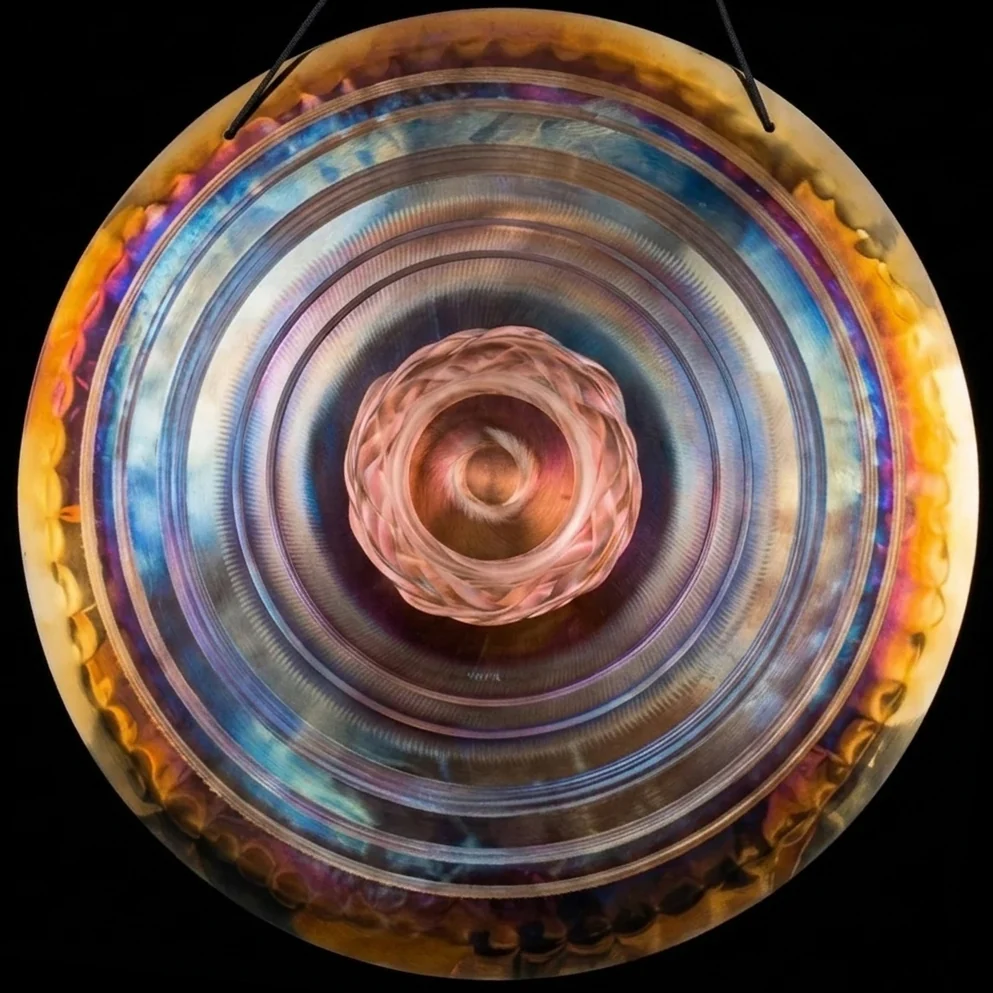
- Shaping by hand. Each gong is formed by hand, one at a time. The surface keeps the marks of that work: the rings, the spirals, the hammered rim.
- Tuning and heat, in rounds. Every instrument goes through several rounds of tuning and heat treatment, which help stabilise the steel and refine its sound. The heat also leaves its colours: gold, violet, blue.
- Listening. We pay particular attention to the relationship between the fundamental and its harmonics, refining each gong until it holds its register with calm and clarity.
- Made for you. Gongs are made to order in small batches. For the 50 and 60 cm gongs you choose the note; for the larger ones, tuning follows what is available in the atelier.
Why stainless steel
Most gongs in the world are bronze. We chose stainless steel for its resistance to corrosion, for the way it keeps its finish with very little care, and for the voice we found in it after years of testing. On request, we also make gongs in nickel silver and titanium. Read more in our guide to gong materials.
Visit the collection
Four sizes, from the 50 cm Handheld Gong to the one-metre Low Bass Gong. If you are a shop, studio or sound space, we would also love to hear from you: partnerships.